Published on
Annual rent growth continued its gradual acceleration in September, rising to 1.5 percent even as asking rents declined slightly month over month. This continues an acceleration trend that began earlier this year. September’s modest increase in rent growth reflects an easing of multifamily market conditions, despite remaining pressure from elevated supply levels.
Annual rent growth continues to accelerate into fall
September’s acceleration to 1.5 percent in September reflects an increase in 20 basis points from the 1.3 percent rent growth posted in August.
Rent growth has gradually moved upwards every month since the acceleration trend began in March. The positive trendline has brought September rent growth well above the 1 percent mark posted during the same month a year ago.
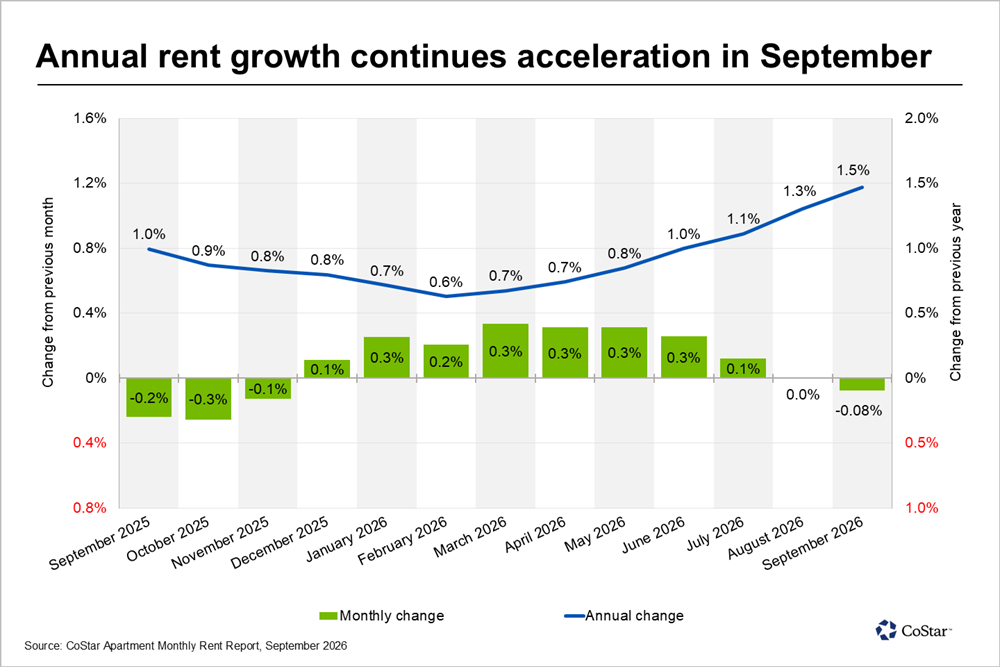
Monthly rent growth, on the other hand, has fallen slightly after remaining flat last month. Asking rents declined slightly month over month, dropping by 0.08 percent. Asking rents averaged $1,752 nationally.
Pacific, Midwest and Northeast regions remain locked in tight race
The Midwest region has led the nation for rent growth since 2022, a position it held until August, when the Pacific region knocked it out of first place in a close tie, with a slight Pacific advantage.
Since then, the Pacific region has maintained its position ahead of the long-time rent growth leader. The Pacific region posted annual rent growth of 2.4 percent in September, with the Midwest and Northeast close behind.
In second place, the Midwest posted annual growth of 2.3 percent, while the Northeast took third place with 2.2 percent.
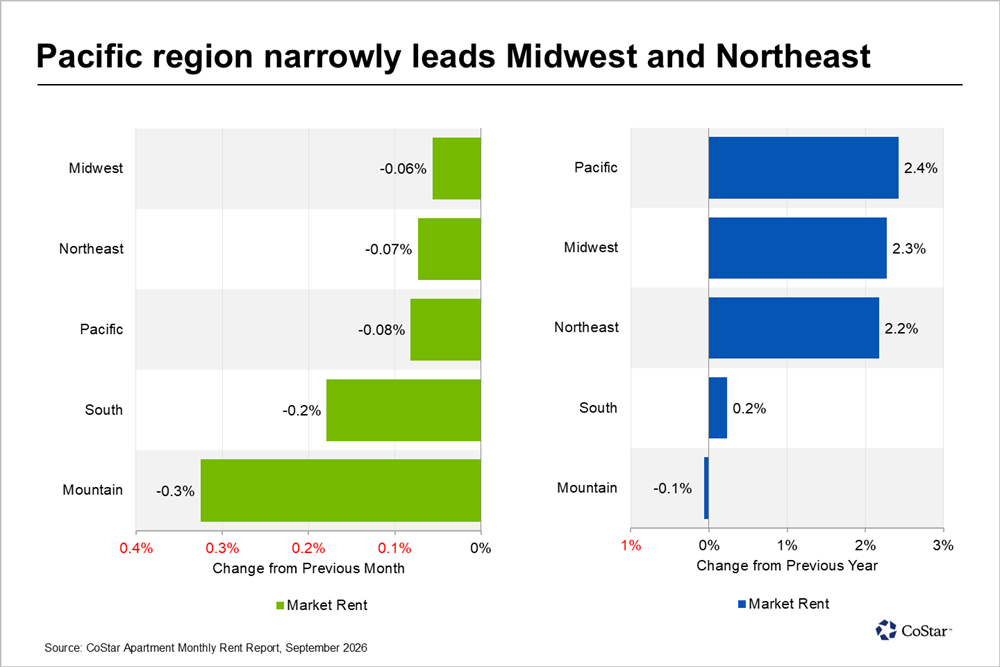
The South and Mountain regions, which were in negative territory the previous month, both posted improvements in September. The South emerged from the red to post 0.2 percent annual rent growth, while the declines in the Mountain region moderated to negative 0.1 percent, or nearly flat growth.
Market-level rent growth leaders hold steady, while gains accelerate
The Bay Area maintained its dominance at the top of the rent growth charts in September, with its major markets taking the first, second, and fourth spots. Annual growth continued to accelerate across the region even as monthly increases slowed.
San Francisco remained the nation’s rent growth leader at 12.8 percent, followed by San Jose at 8.2 percent, while the East Bay posted 5.4 percent annual growth.
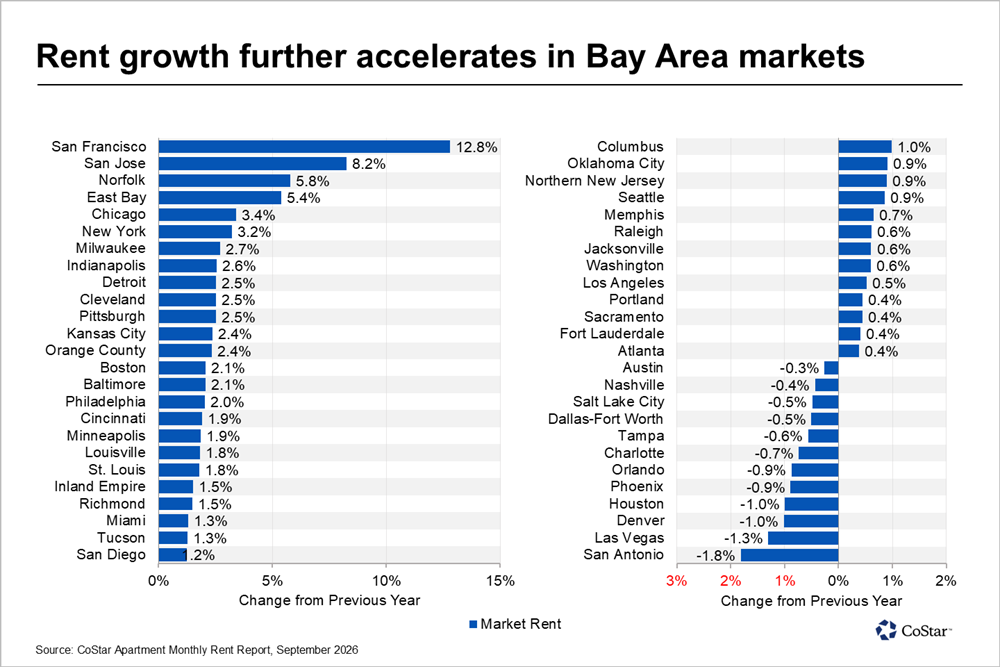
Virginia’s Norfolk market remained in third place nationally, with annual rent growth reaching 5.8 percent. Overall, the seven top markets in August held their rankings through September. These included Chicago in fifth place, posting 3.4 percent; New York in sixth place with 3.2 percent; and Milwaukee in seventh place at 2.7 percent.
Austin begins to emerge from rent growth woes, while struggles remain for San Antonio
At the other end of the chart, San Antonio remained solidly in last place, with negative 1.8 percent rent growth.
Formerly beleaguered Austin, however, continued to move up the rankings. After spending years at the bottom of the rent growth charts, the Austin market has climbed to 12th-from-last place and is on a trajectory to reach positive territory. Annual rent growth for Austin is now nearly flat, at negative 0.3 percent.
Las Vegas has replaced Denver as the second-to-last market on the rent growth chart, posting negative 1.3 percent annual rent growth, compared to Denver’s negative 1 percent.
Explore the full outlook for the rest of the year
Take a closer look at multifamily market conditions this year with analysis from CoStar’s Grant Montgomery, including the outlook for the remainder of 2026. Watch now: