Published on
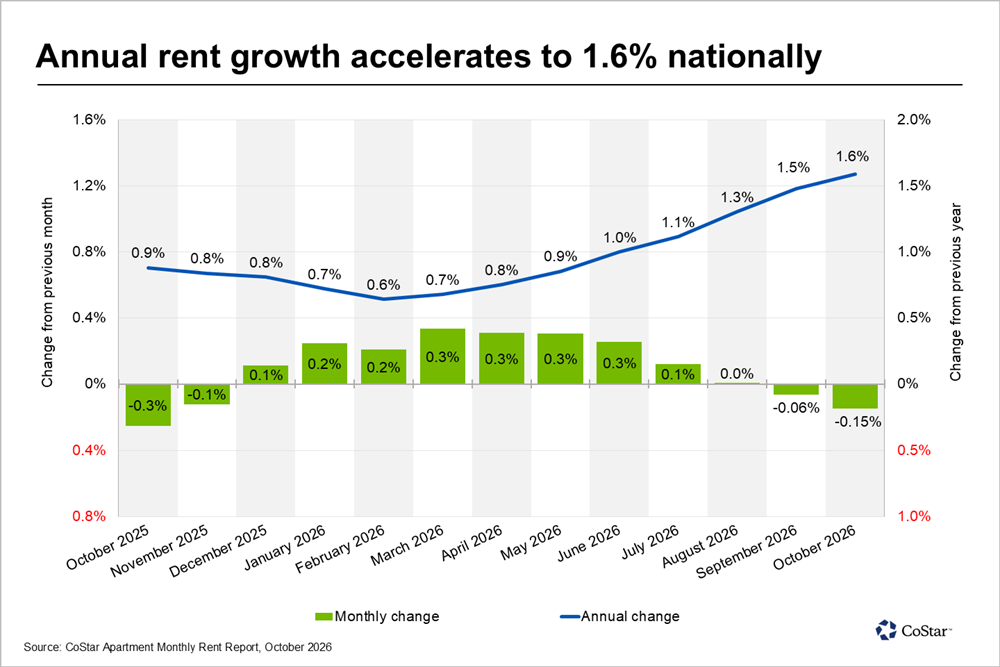
Continuing an acceleration trend that began in March, year-over-year national rent growth increased to 1.6 percent in October, according to the latest rent growth report from Apartments.com.
This marked a slight rise over the 1.5 percent national rent growth posted in September and reflects a gradual easing of the oversupply challenges facing the multifamily market in recent years.
Annual rent growth marks 8-month acceleration trend
After a downward trajectory in late 2025 and into early 2026, national rent growth has been recovering. From a starting point of 0.6 percent in February, annual rent growth has risen every month since, and October marks the eighth consecutive month of acceleration.
The 1.5 percent annual rent growth posted this month marks a significant increase over the 0.9 percent rent growth seen in October 2025.
Driving this acceleration, the multifamily construction pipeline has been slowing down since it peaked in 2024. As of the third quarter, nearly 445,000 units were delivered in the past 12 months. In comparison, over 570,000 units were delivered during the same period as of 2025, itself a drop from over 695,000 in 2024.
All 5 regions reach positive rent growth
As of October, all five regions of the country are now in positive territory.
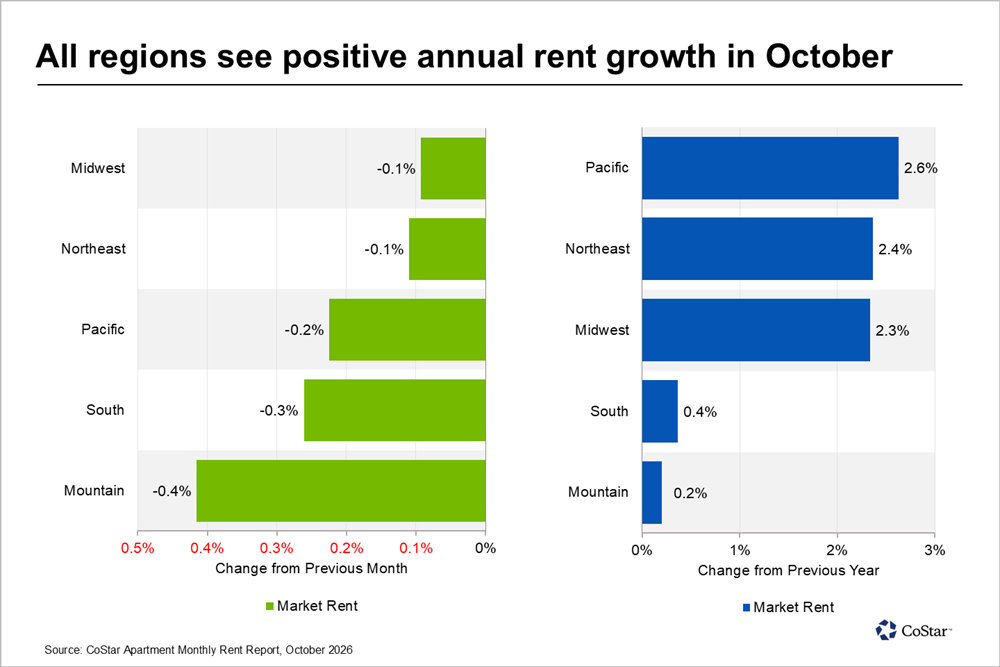
The Pacific maintains its lead with 2.6 percent annual rent growth, and the Northeast and Midwest follow close behind at 2.4 percent and 2.3 percent, respectively. Compared to the rest of the country, these three regions have benefited from a limited development pipeline relative to demand.
The South and Mountain regions trail behind at 0.4 percent and 0.2 percent, respectively. These two regions, both home to relatively aggressive construction pipelines that have driven up vacancy and weakened rent growth, have only recently recovered from negative rent growth.
Bay Area markets take top 3 spots
With annual rent growth of 12.9 percent, San Francisco maintained its crown as rent growth leader, a status it has held for over a year. The double-digit annual growth San Francisco posted in October is over eight times the national average. Rents in the San Francisco market have skyrocketed since 2025, thanks to strong renter demand paired with tight supply.
This demand boom has extended beyond San Francisco. San Jose and the East Bay, the other two major multifamily markets in the Bay Area, have also flown up the rent growth charts. As of October, these Bay Area markets took the top three slots. San Jose posted 8.4 percent, while the East Bay saw growth of 6.3 percent.
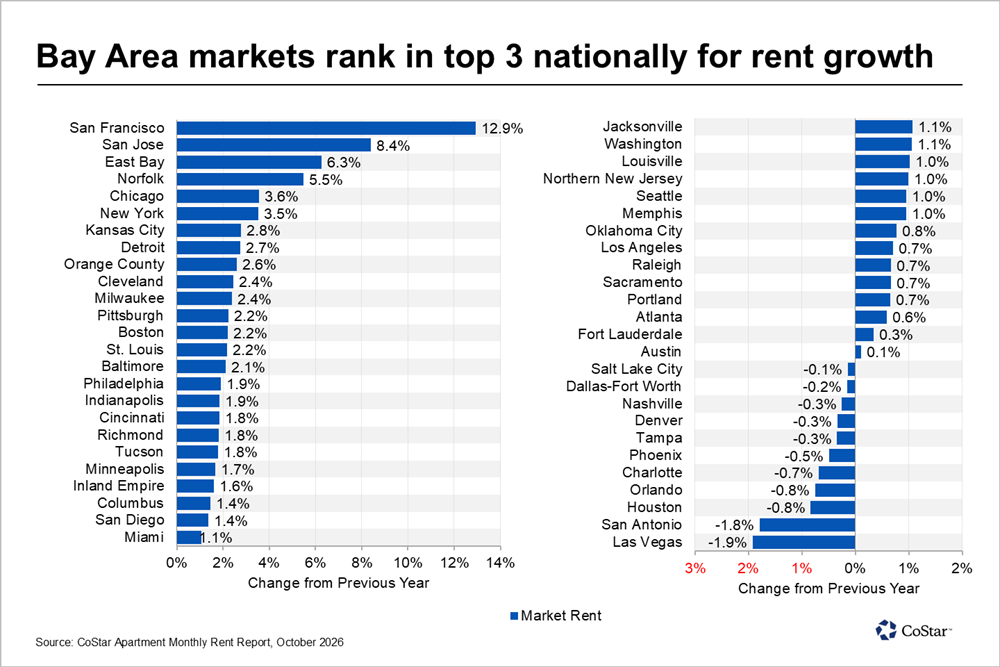
Behind the Bay Area, Virginia’s Norfolk market came in fourth with 5.5 percent, followed by Chicago at 3.6 percent and New York City at 3.5 percent.
Las Vegas the latest rent growth laggard
At the other end of the scale, Las Vegas overtook San Antonio at the bottom of the chart with negative 1.9 percent, slipping just below the former’s negative 1.8 percent.
Both multifamily markets have struggled in recent months, the result of an active development pipeline that has dramatically increased supply since the COVID-19 pandemic. Since 2020, developers added nearly 49,000 new multifamily units in San Antonio and over 26,000 in Las Vegas, CoStar reported last month. Concession use in Las Vegas was 64 percent, according to the same analysis.
Austin, formerly at the bottom of the chart, is officially in the black: the Texas capital posted annual rent growth of 0.1 percent. This follows a climb out of the bottom spot that began in June, when Austin moved from last to third-to-last place. Previously, Austin had sat at the bottom of the chart for years. In response to a pandemic-era demand boom, Austin saw a flurry of construction that resulted in a massive increase in supply additions. At its peak, 20 percent of its total inventory was under construction.
Only 11 major markets posted negative annual rent growth this month. All 11 are in the South or Mountain region.
Get the outlook for the rest of the year
Take a deeper dive into multifamily market conditions. Join CoStar’s Grant Montgomery for a midyear look at the multifamily market, including the outlook for the remainder of 2026. Watch now: