Published on
For over a year, one multifamily market has stood out for its eye-popping rent growth. Already the most expensive rental market by square foot, the San Francisco multifamily market has held the top spot on the rent growth charts since mid-2025. With rents skyrocketing into double-digit growth, San Francisco has posted the nation’s highest rent growth in both relative and absolute terms.
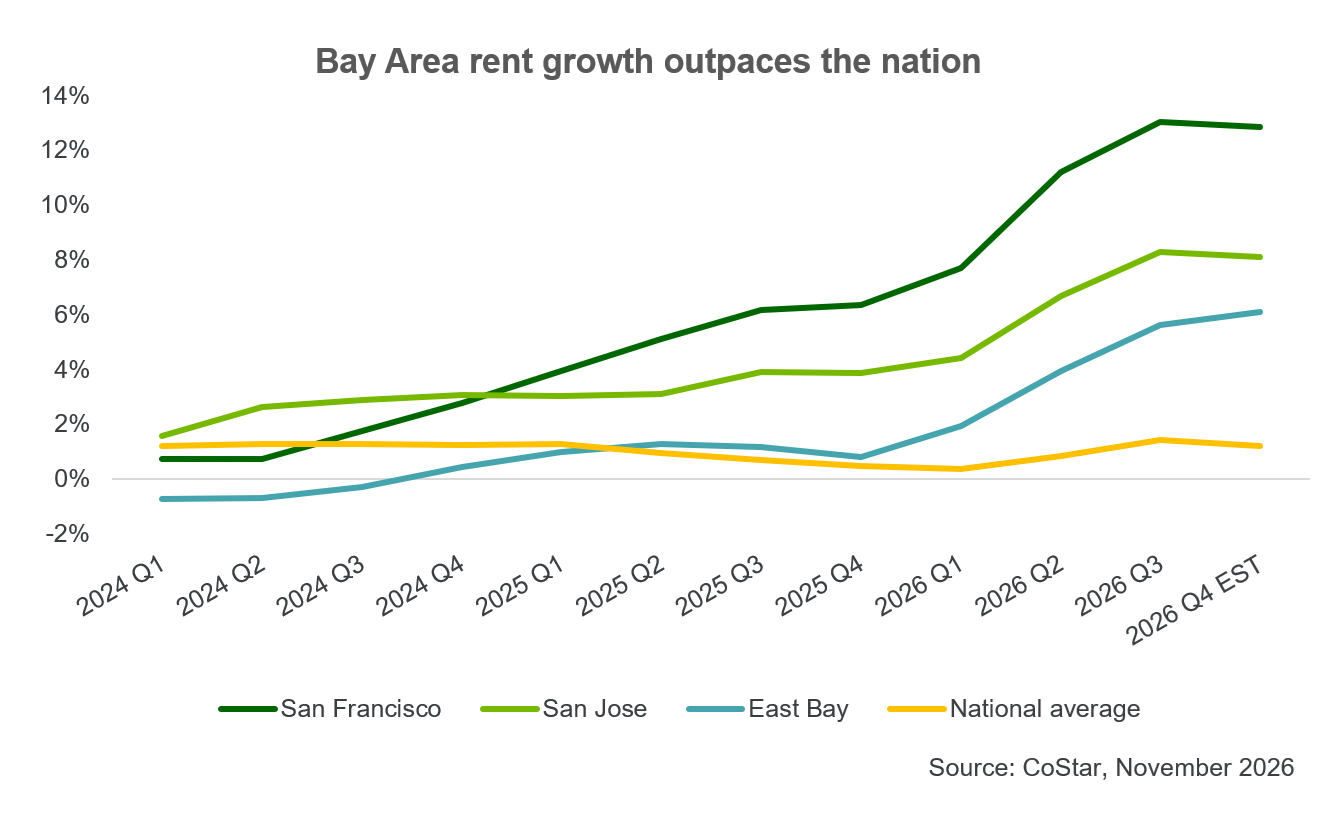
San Francisco’s rapid rise has fueled rent growth throughout the Bay Area, where rents have increased four to eight times faster than nationally.
The San Francisco Bay Area now dominates the rent growth charts. By October, the three major markets of the region — San Francisco, San Jose, and the East Bay — secured the top three spots nationally for annual rent growth.
What’s driving the Bay Area’s rapid rise? Let’s take a closer look.
Rent growth takes off across the Bay Area
San Francisco has led the nation for rent growth since mid-2025, but gains have accelerated throughout this year.
In February, San Francisco posted 5.7 percent annual rent growth. Its rent growth had broken double digits by July and reached 13 percent in the third quarter.
San Jose has followed a similar trajectory, rising from 3.5 percent in February to 8.3 percent in the third quarter. The East Bay, which had lagged behind its neighboring Bay Area markets earlier in the year, has also seen rent growth accelerate, reaching 5.6 percent.
By October, the three Bay Area markets took the first three spots on the rent growth charts for the first time, with San Francisco at 12.9 percent, San Jose at 8.4 percent, and the East Bay at 6.3 percent.
Limited construction pipeline drives down vacancy
Unlike many Sun Belt markets, where aggressive development has pushed vacancy higher and weakened rent growth, multifamily construction has remained limited in the Bay Area. At the same time, renter demand has remained strong, helping these markets maintain some of the lowest multifamily vacancy rates in the nation.
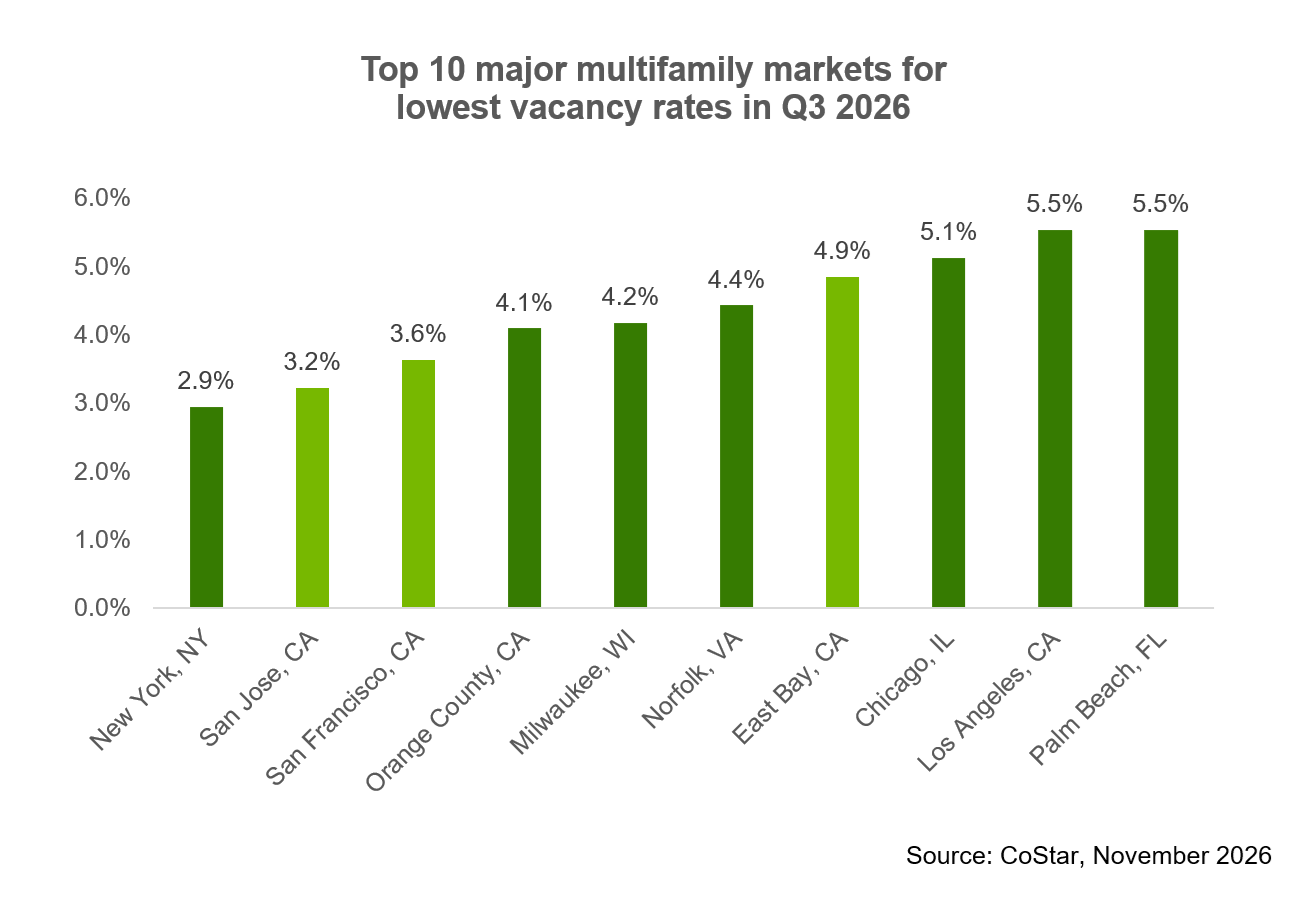
With 3.2 percent vacancy, San Jose was the second lowest vacancy market after New York City, followed by San Francisco in third place with 3.6 percent. The East Bay, at 4.9 percent, came in seventh.
For comparison, the national multifamily vacancy rate during the same period was 7.9 percent, while struggling Sun Belt markets have maintained vacancy rates in the double digits.
Developers in California, and San Francisco in particular, face a challenging environment.
Multifamily development in the Bay Area has long faced significant barriers. Geographic constraints, high building costs, financing challenges, and restrictive regulations make it difficult, expensive, and slow to add new apartments. As a result, the region has largely avoided the wave of new supply that has pushed vacancy higher in other parts of the country.
But in the last year, the limited construction pipeline has narrowed even further.
In San Francisco, for example, developers have added only 515 net multifamily units over the past 12 months, as of the third quarter. In the East Bay, this total was 720, while San Jose saw a negative net change.
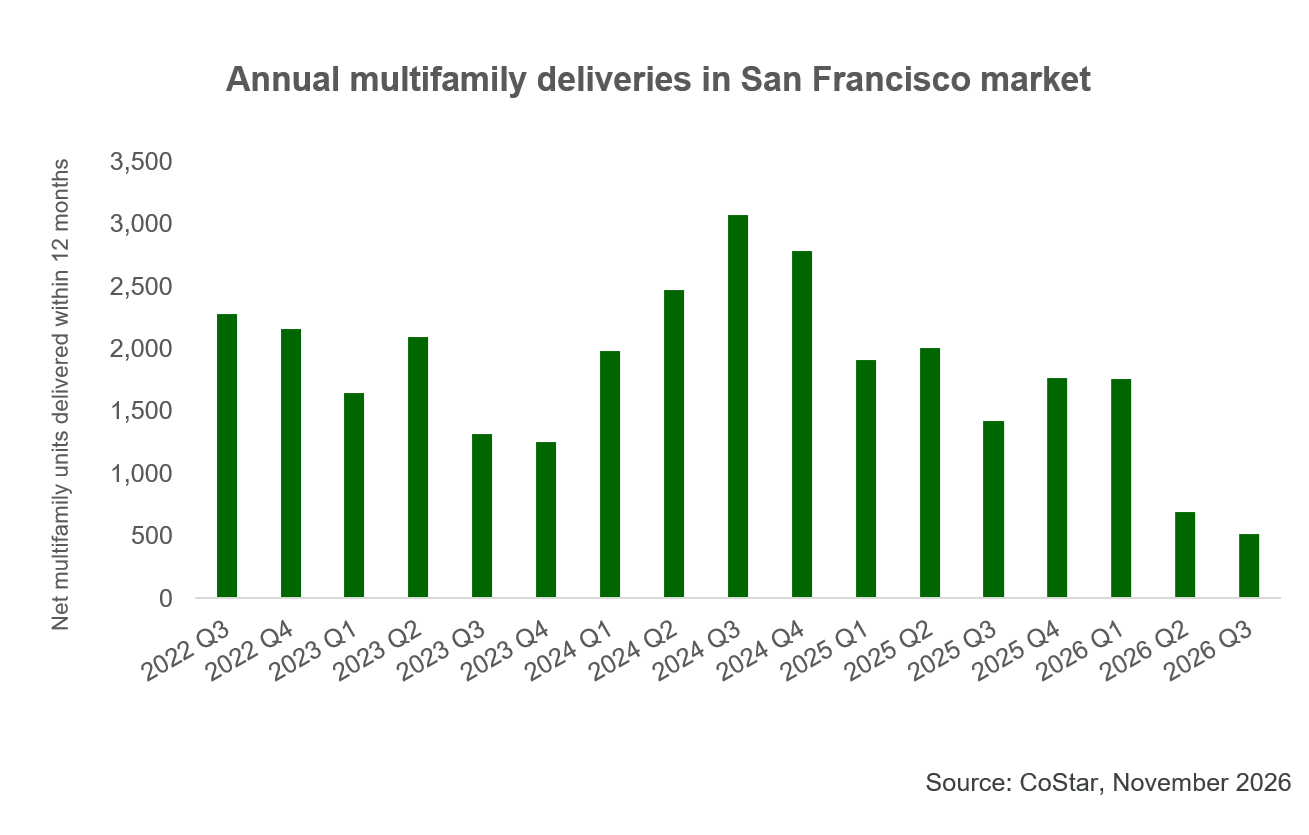
In comparison, the Portland multifamily market — a fellow West Coast market facing similar constraints in terms of construction costs and regulatory barriers — delivered 2,398 net units during the same period, nearly five times as many as San Francisco. The Sun Belt’s Atlanta, known for its active construction pipeline, added 13,268, or over 25 times as many.
AI growth is driving up demand
Supply tells only part of the story. Not only has the construction pipeline narrowed further but renter demand has also taken off, driven by the AI boom in the region’s tech sector.
Renter demand is relatively high in the region, as a result of the high cost of purchasing a home. California ranks second after only New York for its high proportion of renters to homeowners.
Adding to renter demand, the Bay Area’s AI boom has fueled aggressive hiring and job growth, while return-to-office mandates have drawn workers back toward the region’s major employment centers.
These trends have increased rental demand most significantly in tech-heavy San Francisco and San Jose, but the rising demand has also driven up rents in the nearby East Bay market.
What’s more, high tech salaries have strengthened demand for luxury apartments, contributing to the dramatic spikes in asking rents in absolute terms. As of the third quarter, rent growth for four- and five-star properties in the San Francisco market reached 18.1 percent, according to CoStar, compared to 12.3 percent for three-star properties and 4.8 percent for one- and two-star properties.
Low vacancy is translating into some of the nation’s highest rents
The Bay Area was already one of the country’s most expensive multifamily markets before the recent surge in rent growth. Now, rapidly rising rents are pushing those already-high costs even higher.
San Francisco has consistently ranked as the most expensive multifamily market in terms of asking rent per square foot, with San Jose typically in third place after New York City.
With the rapid rent growth in the region, the absolute costs for renters have grown dramatically.
By the third quarter, San Francisco led major U.S. markets with an average asking rent of $5.08 per square foot, ahead of New York at $4.69. San Jose ranked third nationally at $4.08 per square foot, while the East Bay ranked fifth at $3.27.
Rank | Multifamily market | Asking rent per square foot |
1 | San Francisco, CA | $5.08 |
2 | New York, NY | $4.69 |
3 | San Jose, CA | $4.08 |
4 | Boston, MA | $3.39 |
5 | East Bay, CA | $3.27 |
6 | Orange County, CA | $3.25 |
7 | San Diego, CA | $3.13 |
8 | Los Angeles, CA | $3.04 |
9 | Miami, FL | $2.90 |
10 | Seattle, WA | $2.69 |
What’s ahead for Bay Area owners and operators
The region’s combination of limited development, low vacancy and growing renter demand has created unusually favorable conditions for rent growth, with the most dramatic trends seen in San Francisco itself.
Although the conditions driving up rents are expected to continue, the rapid rate of growth is beginning to cool. As of October, San Francisco no longer led for monthly rent growth increases, though it remained at the top of the chart for annual growth.
After reaching 13.0 percent in the third quarter, San Francisco rent growth is projected to decelerate slightly to 12.8 percent by the end of 2026, before gradually slowing to 8.8 percent by the third quarter of 2027 and remaining in the high but single-digit 9.7 percent by the fourth quarter.
More insights from across the multifamily market
What’s happening in the Bay Area is only part of the story. Explore the trends shaping multifamily markets across the country: